Image Not Found

An independent art collective operating in Bulgaria and Czechia.

You have seen them. We all have.

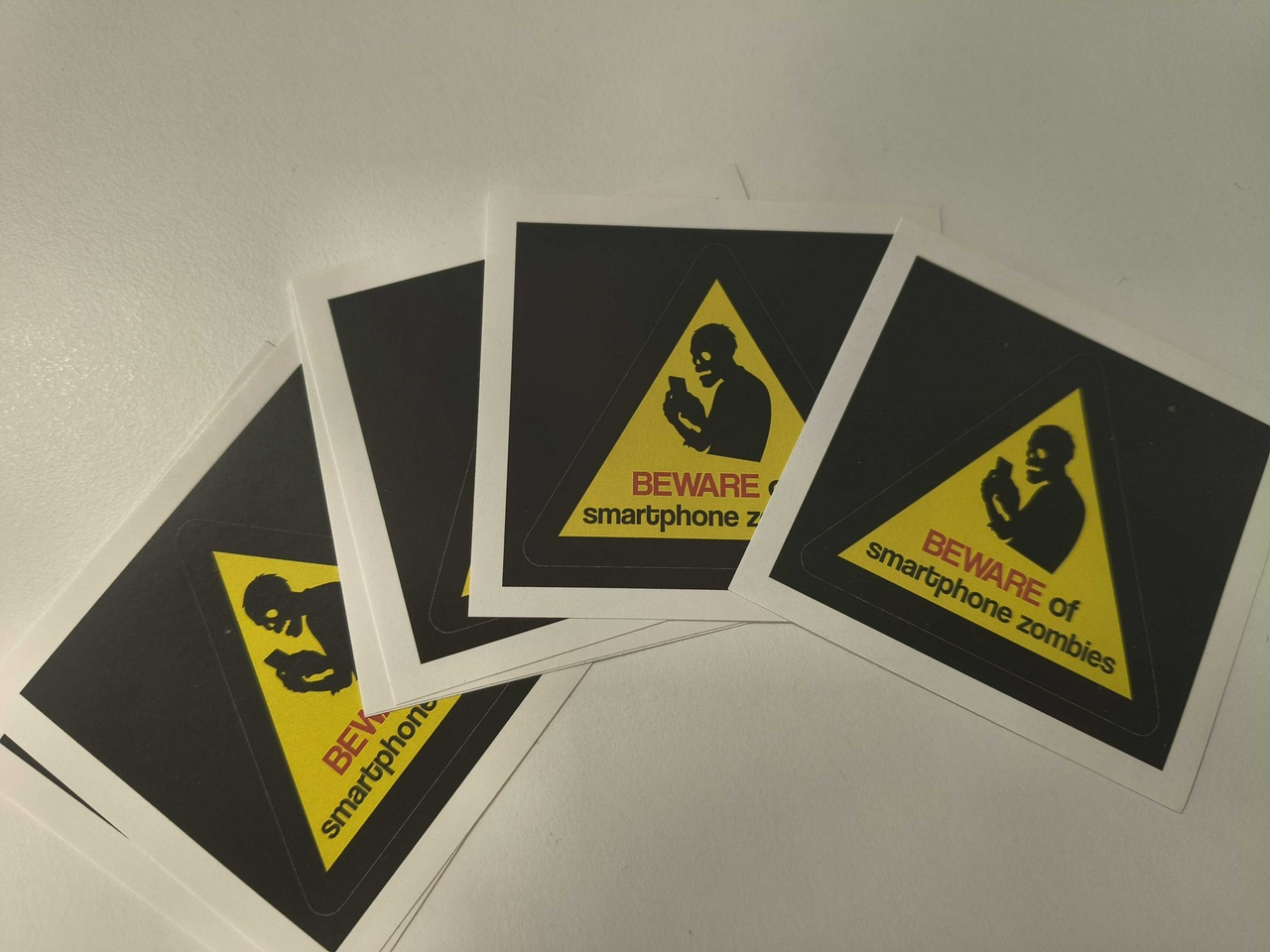
The stickers we made for the smartphone zombies

The person walking towards you on the sidewalk, looking straight down at their phone, not noticing that they are about to walk into you, a tree, a moving tram, or a hole that we have not got around to spray-painting yet.

The person on the metro escalator standing still in the middle of the steps, blocking everyone behind them, eyes glued to a screen.

The kid in the café, sitting across from a parent, both of them on phones, not speaking.

The driver at the red light, who is still scrolling when the light turns green.

We call them smartphone zombies. We are not the first to use that word and we will not be the last. The problem is real, it is everywhere, and most people who see it either shrug, or do the same thing themselves five minutes later.

So we made some stickers.

What is wrong with the zombie

A lot of small things, and a few big ones.

Safety. People walking into traffic. People not hearing the bicycle bell behind them. Parents pushing strollers across the street while reading messages. Kids stepping off a curb without looking up. The first thing that goes when you stare into a screen is your peripheral vision. The second is your hearing, in a way, because your attention is somewhere else and your brain stops processing what your ears pick up. The result is small accidents at best, serious ones at worst.

Attention. The brain is not built to be interrupted every thirty seconds for a notification. People who live like this for years slowly lose the ability to read a book, watch a film without checking their phone twice, or sit through dinner without reaching for a device. This is not opinion. This is what the people who study attention will tell you for free at any conference.

Schools. Walk past a school during a break. Count the kids in groups talking, then count the kids each on their own screen. We did this in three different cities. It is not a happy count.

Mental health. Doomscrolling is a hobby now. Comparison, anxiety, sleep that does not happen because the phone is on the pillow. People know this. People still do it. We know it because we still do it too, sometimes.

Loneliness in a crowd. Two hundred people in a metro carriage and not one of them is looking at another human being. Imagine explaining this to a person from 1995. They would not believe you.

None of this is news. The news is that we keep behaving as if it is unavoidable.

What we did

We printed some stickers. Simple stickers. The kind that fits on a laptop, a notebook, a lamp post, a bathroom mirror, the edge of a table at a café.

The message is short. The design is not subtle. You can see it on the image above, or, with a bit of luck, somewhere in the wild.

Then we did something on purpose. We did not put them behind a paywall. We did not run a marketing campaign for them. We took them to free and open-source software events, the kind of places where people already think a little bit differently about technology, and we gave them away. For free. To anyone who wanted to take a few home and stick them somewhere.

Where they are now

Last we heard, our stickers have made it to:

  • Bulgaria. Where it started.
  • Czechia. Where I am now, and where the campaign jumped first.
  • Belgium. Spotted around the usual Brussels conference suspects.
  • Sweden. Stickers travel well in luggage.

And the list is growing. Every time we hand out a small pile at an event, three or four of them end up in cities we have never been to. People send us photos. We smile. We print more.

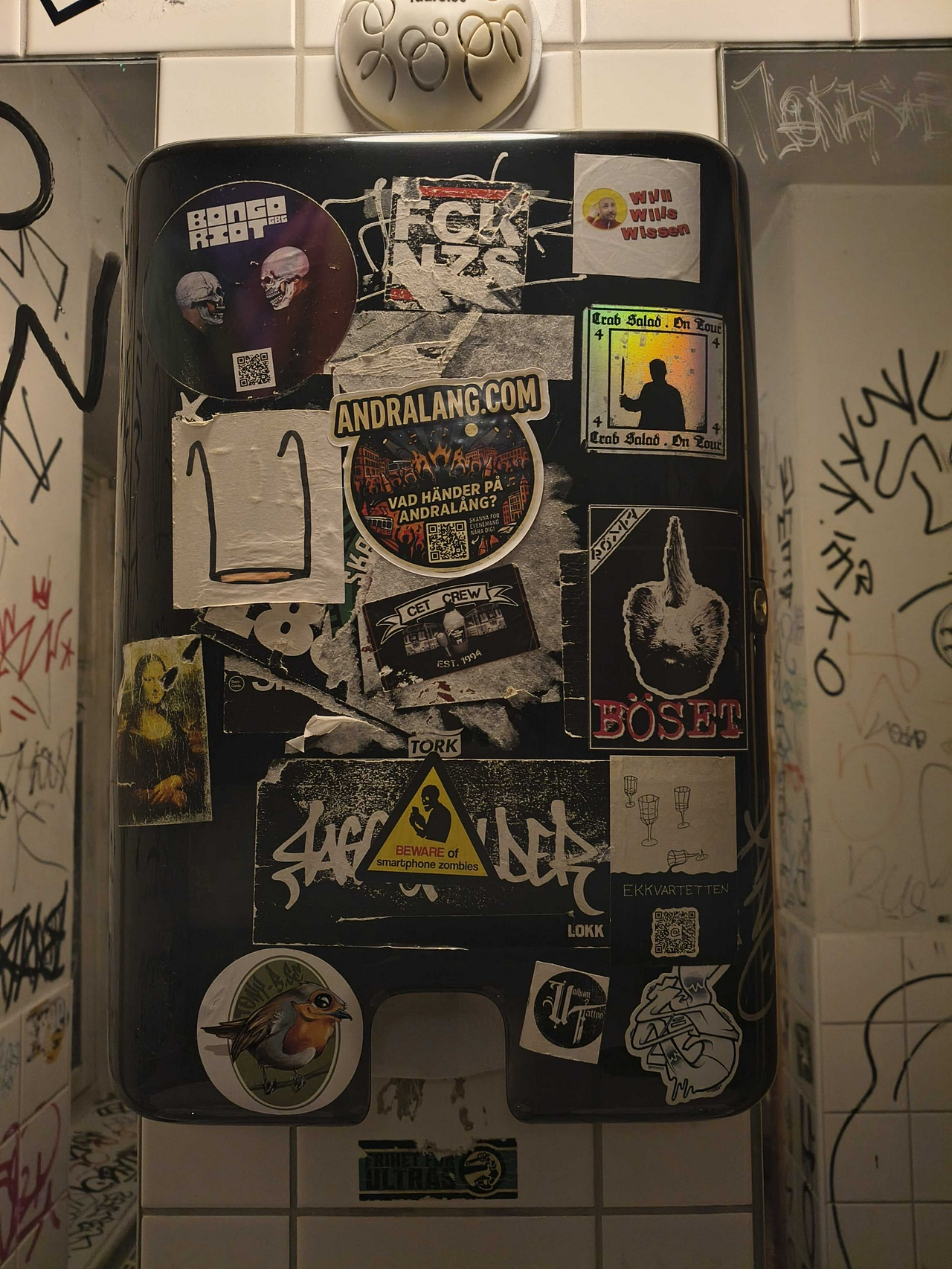
Our stickers in the wild

Join the fight

If you want to help, it is easy.

  • You want a few stickers? Tell us where to send them.
  • You want the print files so you can run your own batch on your own printer, in your own city? We will send them.
  • You want to design your own version, in your own language? Even better. Send us a photo when it is done.

Get in touch

We will not ask you to sign up for anything. We will not put you on a list. We will just send you stickers, or a PDF, and trust you to do the right thing with them.

A word about ARTivism

If you read our story about [painting the potholes](), you already know what we are about. We are a small collective called ImageNotFound, and what we do is part of a wider movement called ARTivism. The idea has not changed: art is a tool, not only decoration. A pencil. A brush. A spray can. A sticker.

This time, the tool is a sticker.

Our slogan, in this campaign, is the same idea in a slightly different shape:

With one small sticker you can change the world.

And we mean it. A sticker on a laptop is a tiny billboard. A sticker on a lamp post is a tiny billboard that thousands of commuters walk past every week. Multiply that by people in four countries and counting, and you start to see why we keep printing them.

For more examples of art-driven change, take a look at our exhibition SystemErr0.

One last thing

Nobody is going to fix this for us. Not the phone companies (they would prefer you stay glued). Not the apps (same). Not the schools alone, not the parents alone, not the government. It is going to be us, one small reminder at a time, on a laptop or a lamp post in a city we have never been to.

You can do this too. Print a sticker. Give it to a friend. Put one somewhere a zombie will see it and, for two seconds, look up.

Some people will say nothing will change.

Do it anyway.

The spray-painted potholes from our original campaign

A bit more than a year ago, we did something a bit weird.

We took a few cans of spray paint and we went out on the street. Not to paint a mural. Not to make art for art's sake. We went out to paint the potholes on a road that the municipality had been ignoring for months. Maybe years. Who can count anymore.

Yes, you read that right. We painted the holes.

Why would anyone do that?

Two reasons.

The small reason: we wanted the holes fixed. People were destroying their cars on that road every single day. We called the municipality. Nothing. We sent emails. Nothing. The usual complaints in the usual Facebook groups went exactly nowhere. So we tried a different language. The language of paint and visibility. If they will not see the hole, we will make sure they cannot not see it.

The big reason: we wanted to show people that you can actually do something. That cursing the government on the bus, cursing the mayor at dinner, and cursing destiny at the kitchen table does not fix a single hole. Action does. Even small, weird, slightly silly action.

“Nothing will change”

That is what some people told us before we started.

“You are wasting your time.” “Nobody cares.” “This is how it is here, my friend, nothing will ever change.”

I get it. I really do. Apathy is the cheapest defense mechanism we have. If you decide in advance that nothing works, you never have to feel disappointed when something does not work. You also do not feel anything when something does work, but that is the trade-off some people pick.

We did it anyway.

What actually happened

A few things, in roughly this order:

  • People walking by stopped, took pictures, and laughed.
  • Local media picked it up.
  • The municipality (surprise) fixed the holes within a couple of weeks.
  • A few neighbours who told us “nothing will change” went quiet. A few said “OK, but this was a fluke.”

And then, Sofia

Here is the part I like most.

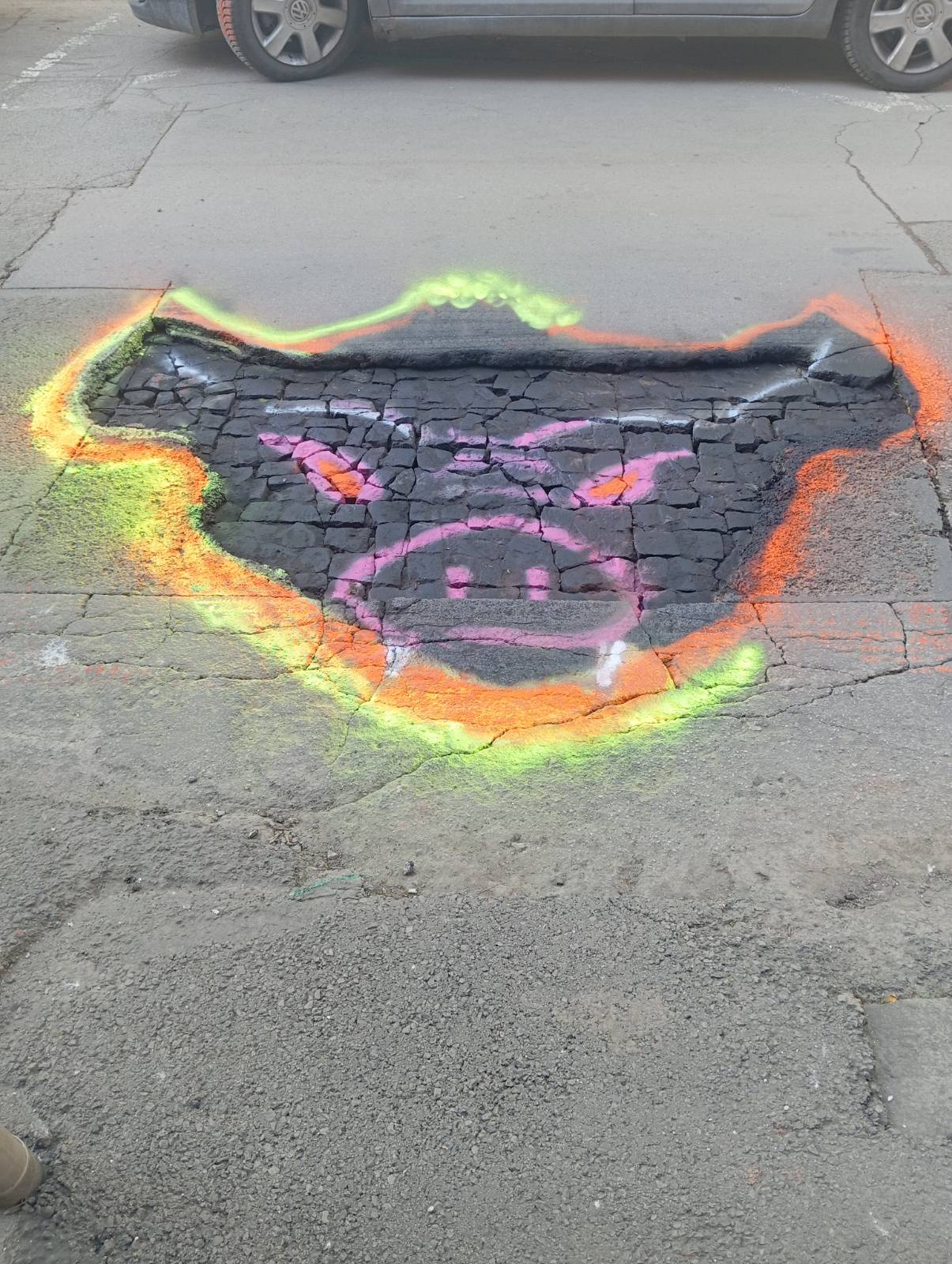
A few weeks ago, on a street in Sofia, Bulgaria, the same thing happened. Different city. Same idea. People went out, found a pothole that the municipality had been pretending not to see, and made it impossible to ignore. Spray, camera, and a bit of noise. Enough to turn a hole in the asphalt into a story.

This time the TV showed up. A real crew. A real segment. The hole, the bright paint around it, the smiling neighbours, all on the morning news. The municipality, again, suddenly remembered that road existed.

The Sofia street with the painted pothole

Do I know the people who did it?

Let's say I am not surprised. Let's say ideas travel. Let's say they travel through articles, through conferences, through coffees, and sometimes they travel from one painted hole on one street to another painted hole on another street, in another country, a year later. Let's say I might have a personal reason to smile at this particular news segment.

I will not say more than that.

The point is not who did it. The point is that someone did. Someone watched, took the idea, made it their own, and went out on their own street.

That is how this is supposed to work.

The campaign was not really about potholes

The potholes were the excuse. The real campaign was against something much harder to fix than a damaged road. It was against the belief that ordinary people cannot move the system.

You can. Not always. Not predictably. Not on the timeline you want. But you can.

So here is the playbook, if you want one:

  • Pick something small. Not the whole broken system. One pothole. One sign. One absurd rule.
  • Make it visible. Spray paint, photo, video, a sticker, a banner. Something the people in charge have to either fix or explain.
  • Get one friend. Just one. Two people is already a movement when most people are doing nothing.
  • Expect the “nothing will change” crowd. They will show up. Smile at them. Keep going.
  • Document it. So the next person sees that it worked, and tries something of their own.

A word about ARTivism

This pothole story is not a one-off. It is part of something bigger that we call ARTivism.

ARTivism is a collective. The idea is simple. Art is not only for galleries. A pencil, a brush, a camera, a sticker, a song, a poster, these are also tools of change, not only of decoration. We try to show people, by real examples, that you can use whatever creative skill you already have to push the world a little.

You do not have to wait for permission. You do not have to be a famous artist. You do not have to have a budget.

Our slogan is short and we mean every word of it:

With one small pencil you can change the world.

That is not a poster line. That is the whole strategy.

If you want to see more examples of art-driven change, take a look at our exhibition SystemErr0.

One last thing

A pothole on a road is a pothole on a road. But a pothole sprayed bright, photographed, shared, and laughed at, is something else. It is a small proof that the citizen and the system are not as far apart as we like to think.

You can do this. Not for every problem. Not every time. But more often than you believe right now.

Some people will say nothing will change.

Do it anyway.

We know a lot of people in #Prague involved and interested in art. We think this small community is quite fragmented. We will try to do monthly meetups in interesting places in Prague to bring it together and see if something inspiring can happen.

meetup location

Register

If you would like to attend and you speak Bulgarian the registration is more than desirable. Make it here so we know how many seats to reserve.

If you create or have an interest in art you are welcome.

The first drink is on us

Discuss...

Enter your email to subscribe to updates.