Paint the cameras dead: The postcards for people who still look up
A camera is a strange object. It hangs on a wall pretending to be invisible. It sits on a pole pretending to be part of the architecture. Sometimes it is black, sometimes white, sometimes hidden in a smoked plastic bubble so you cannot even see where it is looking.
And after a while you stop seeing them. Maybe that is the whole point?
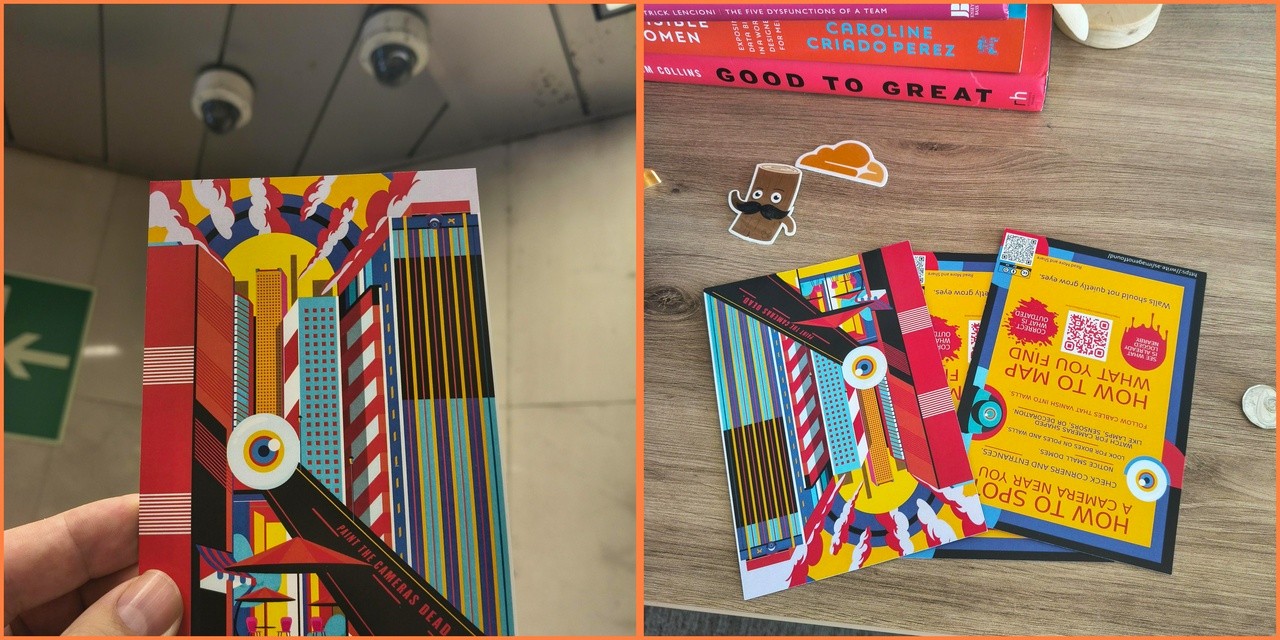
You walk to work under them. You buy bread under them. You enter buildings under them. You wait for friends under them. They become part of the weather.
Clouds, traffic lights, cameras.
Looking up again
People have already started mapping cameras.
The information exists.
People have already walked around cities noticing what most others ignore. They looked up, documented things, added locations, corrected information and made invisible infrastructure a little less invisible.
We liked that idea.
Not because every camera is evil. Not because every camera is secretly controlled by some underground supervillain sitting in a volcano.
Mostly because people should know what surrounds them.
And because most people still walk underneath cameras without ever noticing them.
That is where we come in.
We want to help people see them.
To know where to look.
To recognize the small black domes, the boxes on corners, the cameras pretending to be lamps, sensors or decoration.
Because once you notice something, you start asking questions.
Who installed it?
What is it recording?
Is it public?
Private?
Temporary?
Permanent?
Is it watching a doorway or swallowing an entire street?
Questions are useful things.
Surveillance prefers people who never ask them.
The postcards
So we started working on postcards.
On the front: real-world examples. Cameras above doors, cameras hiding in corners, cameras attached to poles, cameras pretending to be decoration.
On the back: instructions.
Simple things.
Look up.
Look at building corners.
Notice small black domes.
Check entrances.
Look for cables that suddenly disappear into walls.
And then if you find one, map it. Add it. Correct information. Leave the place a bit more visible than you found it.
Not visible to cameras.
Visible to people.
Paint the cameras dead
Our campaign says: Paint the Cameras Dead.
Not because paint is always paint.
Not because dead always means dead.
Because things only become untouchable when people stop seeing them.
Because surveillance works best when it becomes background noise.
Because walls should not quietly grow eyes.
Our older slogan was with one small pencil you can change the world.
This time the pencil may not even be a pencil.
Maybe it is a marker.
Maybe a sticker.
Maybe a stone.
Maybe something much more creative.
The important thing is not the object.
The important thing is noticing that the wall was watching you before you started watching back.
How you can help
Small campaigns survive on small actions.
If this idea makes sense to you, here are four ways to help:
0. Map the cameras around you
Take out your phone.
Visit this url.
See what's around you.
Start looking up and map what's not there.
1. Follow our messages and spread them
Watch our Mastodon posts and repost them.
Share the noise with your own network. Algorithms like it.
Help the message travel a little further than we can push it ourselves.
2. Print the postcards and let them travel
When the files are ready, get them from us.
Print them.
Leave them in places where people pass through and pause for a moment.
Community spaces.
Cafés.
Libraries.
Universities.
Notice boards.
Unexpected places.
The goal is simple: put the idea where eyes already are.
3. Support the work
Image Not Found survives because people decide small things are worth supporting.
If you want to help us make more postcards, more interventions and more weird little projects that interrupt everyday life, you can also donate.
One last thing
Surveillance likes passive people.
Noticing things is active.
Sometimes changing the world starts with looking up instead of looking down.
Some people will say nothing will change.
Do it anyway.
Subscribe to our RSS | About Us | Discuss... |